Tuesday, December 7, 2010

La Chasse


Chiens de Chasse


Sanglier


Sanglier

Hunting in France is, at least in rural parts, an institution. I have been meaning to do a post about this since September, which was the official start of hunting season, or la chasse, here in France. Since the month of September, at least in the countryside, it has sounded as if rehersals were being held for WW3, and as a result, there has been a noticeable lack of birdsong. I've assumed all sensible or experienced birds fled at the sound of the first shot for somewhere safer like North Africa. Throughout these past fall and winter months I can honestly say that I've seen enough hunters, dogs and weaponry to wipe out the entire thrush and rabbit population of southern France.

I remember my first encounter with a red-blooded French hunter one early morning back in September. There is a small wooded area filled with trails, what most europeans would call a forest, between our house and the ocean where Rypien and I run every morning and walk every afternoon. We were about halfway through our usual morning run one sunny day when all of a sudden BANG! BANG! We both stopped dead in our tracks and stayed still for several seconds as it sounded like anything that moved would be at risk. We eventually decided to continued on, with infinite caution, and as we rounded the corner he appeared, the chasseur du sentier, or footpath hunter.

I would have assumed that any hunter worth his gun license would have moved well away from the friendly trails and into the tangled undergrowth deep in the forest or high up into the mountains. However, they hadn't gone up into the forest or the mountains; in fact, they had barely left the footpath! Do these stooges not want to get their boots dirty in a real forest? Or maybe they just like to sit around, smoke cigarettes and hope that birds will somehow fly into their buckshot.

For the most part, the chasseurs I've come across are dressed like commandos in full combat uniform with all the gear to match - guns, bullets, rifle slings, compasses and fearsome knives in case ammunition ran out and game had to be attacked with cold steel. They are equipped with everything a man might need for his confrontation with the untamed beasts of the forest footpaths except that indispensable accessory with four legs and a nose like radar, the hunting dog.

Each hunting dog, or chiens de chasse, seems to wear a thick collar with a small brass bell – the clochette – hanging from it. I've been told that this has a double purpose. It signals the dogs whereabouts so that the hunter can position himself for the game, but it also serves as the precaution for shooting at something in the bushes that sounded like a rabbit or boar and finding that you had shot your dog instead.

No responsible hunter, would ever shoot at something he couldn't see – but I have my doubts. A rustle in the bushes might be too much for an over eager hunter to resist, and the cause of the rustle might be human. In fact, it might be me. I've thought about wearing a bell, just to be on the safe side.

Apparently, they are usually after deer, game birds such as partridge or pheasant and sanglier (wild boar), not blonde girls from Canada with a cute dog. I should mention that I have never once laid eyes on any one of the above mentioned animals on any of my runs or walks.

The sangliers are a rather elusive animal, black and stout with whiskery faces and longer in the leg than the conventional pig. I love my rare glimpses of them, and wish the hunters would just leave them alone. Unfortunately, these poor creatures taste like venison (so I've been told) and are consequently chased from one end of France to the other. During my drive over to the Languedoc to start my wine course I saw one of these mysterious creatures running across a beautiful field, about two seconds later I saw a hunter with his gun aimed directly at it. Bang! I was mortified! The poor sanglier, he probably didn't stand much of a chance.

Tuesday, November 30, 2010

Loire Valley


Chateau de Pray.


Chateau de Pray.


Chateau de Pray.


Chateau de Pray.


Our Room, Chateau de Pray (There was another bed against the wall).


Chateau de Pray.


Chateau de Pray.


Amboise.

After spending a few days immersed in the gore of D-Day and WWII it was time to lighten the mood. And what better place to lift one's spirits then the Loire Valley, land of castles and wine! The Loire Valley is chalk a block full of chateaux, more than three hundred! Unfortunately, we didn't have a whole lot of time to properly explore this beautiful part of France. The things we did manage to do and see were absolutely fantastic and stunning, especially the Chateaux of Chambord and Chenonceau. We stayed at the lovely and very beautiful Chateau de Pray perched on the terraced slopes overlooking the Loire River just outside Amboise. However, the best part was just being able to spend time with Dad! Thanks for a great trip Dad, Love You!

Chateau de Chambord


Chateau de Chambord


Chateau de Chambord


Dad about to Ring the Doorbell.


Francois I


One of the 440 Rooms.


The Famous Double Staircase.


Louis XIV Ceremonial Bedroom.


Louis XIV Ceremonial Bedroom.


Bust of Louis XIV in his Bedroom.


Louis XIV Ceremonial Bedroom.


The Hunting Room.


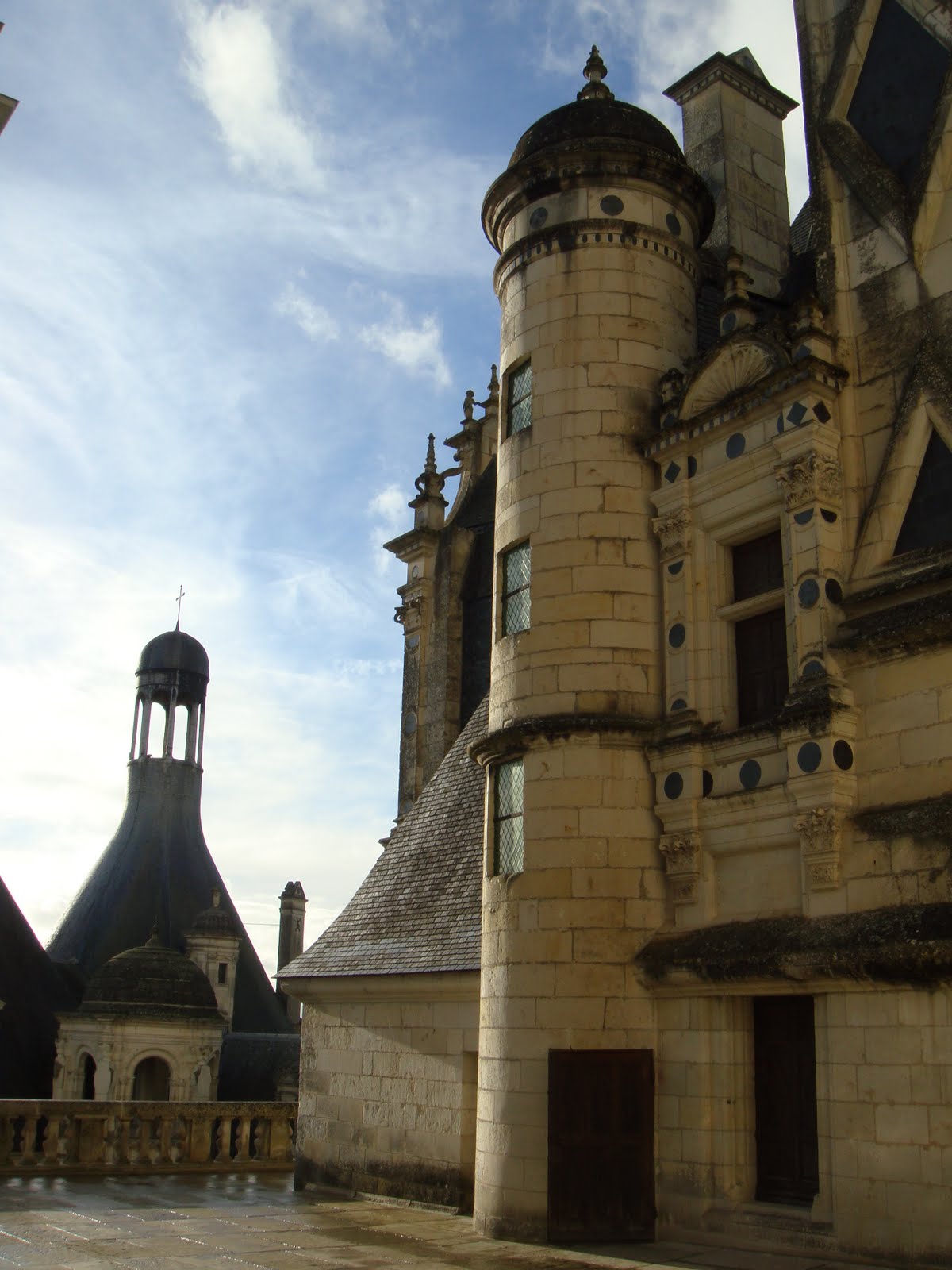
On the Roof.


On the Roof.


On the Roof.


On the Roof looking towards the front yard.

To understand Chambord, you have to appreciate the elation and extravagance of Francois I who, at the tender age of twenty-five, wanted to show the world in spectacular fashion what his two favourite pastimes were: hunting and architecture.

The sheer gargantuan scale of the place is awe-inspiring, it is without a doubt a stone colossus. It was originally built as a hunting lodge, however, the cold drafty size of the Chateau made it largely unpopular as an actual residence. The structure contains 440 rooms, 365 fireplaces, 13 great staircases, and stables to accomodate 1200 horses.

The shadow of Leonardo da Vinci, perhaps the official 'architecteur', who died a few months before the construction work began in 1519, hovers over the astonishing and famous double spiral staircase.

Francois I only stayed at the Chateau for a few weeks each year to hunt in the surrounding woods. All the furniture, wall coverings, eating implements and so forth were brought specifically for each hunting trip leaving it devoid of furniture and inhabitants after each visit, a major logistical exercise. After Francois I died in 1547, the Chateau was barely used for almost a century. Chambord was not properly finished until the reign of Louis XIV, who well in love with this presitigous site.

The Chateau is now part of a 5,440 hectare estate, surrounded by a 32 km wall, which makes it the largest enclosed forest park in Europe. Its surface area is practically the same size as inner Paris! It is home to a variety of animals including stag and boar which were the animals Francois I came to hunt, they are now the symbolic species of Chambord.

Sunday, November 28, 2010

Chateau des Dames


Entering the Chateau Grounds.


Entering the Chateau Grounds. Beautiful!


The Impressive Driveway, No Cars Allowed.


The Chateau!


Entrance Statue, Chateau Chenonceau.


Chateau Chenonceau.


Inside, Entrance to Chanteau Chenonceau.


Diane de Poitiers


Flowers.


The scuttling of many feet over the centuries has taken its toll on the beautiful tile floors. Vestiges of its decoration are visible only around the edges of the Guard's room.


The Chapel inside the Chateau.


I think this room was called the Gallery.


The Gallery.


The Bread Oven.


Pots and Pans.


The Stove!


Where the Servants Ate.


I Just Loved These Flower Arrangements, They had Them in Every Room of the Chateau.


More Flowers.


Looking out from the Chateau.


One of the Many Beautiful Buildings on The Chateau's Grounds, this one was right Beside the Gardens.


Gardens.


Gardens, Chateau Chenonceau.

One of the most visited castles in France, Chateau Chenonceau is a Renaissance chef d'oeuvre that stands firmly in the river Cher. One of a garland of Loire Valley castellar beauties, Chenonceau is most known for the influential women who held sway here, giving it the sobriquet Chateau des Dames (Ladies Castle). It was built in 1513 by Katherine Briconnent, then made even more attractive by Diane de Poitiers and Catherine de Medicis, and saved from the rigours of the French Revolution by Mrs. Dupin.

The enchanting castle may be smaller in comparison to others, but what it lacks in size it makes up for in charm. Throughout its interior there is an arresting array of tapestries, paintings, ceilings, floors, fireplaces and furniture on show. The chateau's exquisite surroundings include 70 hectares of forest park, stables, an intricate hedge maze, several immaculate gardens and a wax museum which shows all the women who built Chenonceau as well as a sumptuous collection of costumes.

The many gardens are ornamented with a myriad of shrubs, hedges and hundreds of climbing and stemmed roses. There are over 4000 flowers grown on the castle grounds, which are planted twice a year in spring and summer. In the summer months, visitors can even rent paddle boats at the castle to ride down the Cher river.

My favourite part of the whole Chateau were all the fabulous bouquets of fresh flowers. Each room of the Chateau was adorned with a truely original floral composition prepared by the Chateau's own team of florists. The flowers are grown in a garden strictly reserved for putting together these fabulous flower arrangements - the bouquets are renewed twice a week.